

CSA Progression ARC™
Where Every Child's STEM Journey Becomes Visible
CSA Progression ARC™ is our structured, XP-tracked learning framework for AI Coding, Robotics and STEM Makers
—
built on 60 years of cognitive science and aligned to the K–12 CS Framework.
The Science Behind the Learning
Built on Four Pillars of Learning Science
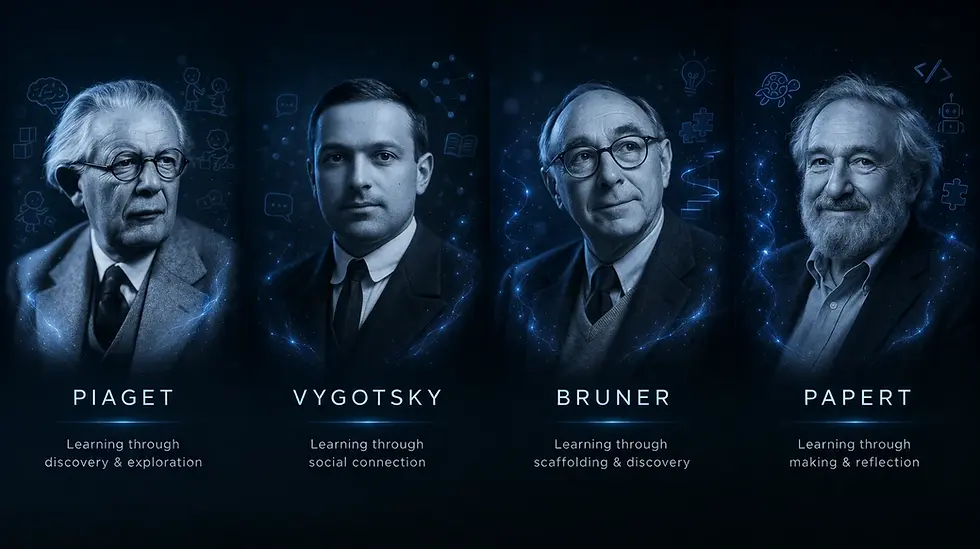
CSA Progression ARC™ is not a syllabus — it is a philosophy made visible. Every level, every project, every XP point is grounded in the work of four giants of learning science.
PIAGET
Learning through discovery & exploration. Children construct knowledge by doing. Each CSA project gives students a concrete challenge to explore before any concept is named — exactly as Piaget described.
VYGOTSKY
Learning through social connection. Growth happens at the edge of what a child can do alone. CSA teachers act as skilled guides in that zone, scaffolding just enough to keep every student moving forward.
BRUNER
Learning through scaffolding & discovery. Concepts spiral back at greater depth each year. A student who builds a Wheels Bot in Year 1 revisits motion, control and feedback in Python and AI by Year 5 — the same idea, richer each time.
PAPERT
Learning through making & reflection. Real learning sticks when children make something shareable. Every CSA project ends with a working artefact — a game, a robot, a trained model — and a moment to explain what they built.
The CSA Progression ARC™ · Live Framework View
Seven Years. Three Programmes. One Clear Path.
The ARC visualises every student's live progress across three programmes
— AI Coding, Robotics and STEM Makers.
XP earned in each session lights up the wire.
🔴 AI Coding · L1–L6 From Scratch storytelling to Python AI and generative models. Students write real code from the very first lesson.
🟡 Robotics · L1–L6 Wheels Bots to coded, sensor-driven machines. Hardware and software taught together, from design challenges, competitions to custom builds.
🟢 STEM Makers · L1–L5 From crafting prototypes, soldering, to IoT inventions.
Engineering thinking, circuits and design challenges that make abstract science tangible.
Framework Parents Can Actually Follow
Structured. Transparent. Proven.

Most enrichment centres give you a syllabus.
CSA gives you a living map of exactly where your child is, what they have mastered and what comes next.
Framework alignment badges:
-
✦ K–12 CS Framework · ACM · Code.org · CSTA · NMSI
-
✦ MIT App Inventor · MIT Media Lab · Scratch · Lifelong Kindergarten
-
✦ DSA preparation pathway
-
✦ Applied Computational Intelligence Institute™
-
✦ Explainable Intelligence™ Framework
Why Families in Singapore Choose CSA
01
Progress You Can See The CSA Progression ARC™ gives every parent a real-time view of their child's XP, level and competency scores — no guesswork, no vague "doing well" updates.
02
Curriculum Built on Science Not worksheets. Not drills. Every CSA lesson is designed around how children actually learn — through making, discovering, explaining and reflecting with their peers.
03
A Path to Real Skills By Level 4, students are writing Python. By Level 5, they are training AI models. By Level 6, they have a portfolio of real projects to show secondary schools and beyond.
COMPETENCY STARS
More Than Grades
— We Track How Children Think
The Five Competencies We Measure
Every CSA session, teachers rate each student across five competencies. These feed directly into the ARC and drive the visual effects students see on their progression wire.
Five competency blocks:
🔨 Build & Make
Can the student construct, assemble and produce a working output? Measured on every hands-on task.
⚙ Logic & Code
Can the student apply computational thinking — sequences, loops, conditions — to solve a problem?
🔍 Troubleshoot
When something breaks, can the student diagnose and fix it independently or with minimal guidance?
💡 Explainability
Can the student articulate what their programme or robot does, and why they made those choices?
🤝 Teamwork
Does the student contribute, listen, share and support peers during collaborative projects?
SOCIAL PROOF
What CSA Families Say
FAQ
Q: What age is CSA suitable for?
A: CSA programmes run from ages 7 to 18, mapped to Primary 1 through Secondary school. The ARC is designed to grow with your child across all seven levels.
Q: Does my child need prior coding experience?
A: Not at all. Level 1 starts with Scratch and assumes no prior experience. We have students who join at Level 1 as late as Primary 4 and catch up quickly.
Q: How is CSA different from school ICT lessons?
A: School ICT covers digital literacy. CSA teaches computational thinking, programming, robotics engineering and AI — skills that go well beyond the school syllabus, mapped to the international K–12 CS Framework.
Q: What is the CSA Progression ARC™?
A: It is CSA's proprietary student progress framework — a visual, XP-tracked system that shows exactly where a student sits across AI Coding, Robotics and STEM Makers at any point in time. Every lesson updates it in real time.
Q: Is there PSLE preparation support?
A: Yes. Our L3–L4 pathway is timed to support students through the PSLE years, with a focus on logical thinking, problem decomposition and structured explanation — skills that transfer directly to PSLE Higher-order thinking questions.
Q: How long are the programmes?
A: Each level typically runs one academic year (about 40 sessions). Students progress at their own pace and are assessed on all five competency dimensions before levelling up.
Q: Where are you located?
A: Cognitive Systems Academy™ is based in Singapore. Contact us for current centre locations and trial class availability.
Access Your Child's Progression Here
A program of Applied Computational Intelligence InstituteCurriculum powered by the Explainable Intelligence™ Frameworkwith research support from the Cognitive Intelligence Lab

CSA Progression ARC™ · Cognitive Systems Academy™ · Applied Computational Intelligence Institute™ · Aligned to K–12 CS Framework · Piaget · Bruner · Vygotsky · Papert · MIT